

Submitting a book manuscript can feel like walking into a room where everyone already knows the rules. You finished the draft, you’re proud of it… and now you’re staring at “submission guidelines.” Wondering what to send, where to send it, and how not to waste months on dead-end submissions.
In this guide, you’ll learn how to submit manuscript to publisher the professional way—step by step. We’ll cover what “unsolicited submissions” really mean, how to find publishers accepting unsolicited manuscripts, what to include (query letter, synopsis, sample pages), and how to avoid the most common mistake: submitting too early with the right story but the wrong package.
What “Submit Manuscript to Publisher” Really Means Today
When authors say they want to submit manuscript to publisher, they usually mean one of three routes:
1) The literary agent route
You query a literary agent first. If they sign you, they pitch your manuscript to editors. Many large publishers primarily take agented work.
2) Direct submissions (unsolicited submissions)
Some publishers will review “unagented” work. “Unsolicited” usually means they’ll consider your submission without an agent—as long as you follow their submission guidelines exactly.
3) Small presses and independent presses
Many small presses accept direct submissions (often in specific genres or during open reading periods). A good small press can be a strong, reputable path for first-time and indie
authors.
Common Mistake: Treating every publisher like they’re the same. Fit matters more than
volume.
If you want more publishing roadmaps (traditional and indie), start on the LiberoReads blog.
Step-by-Step: How to Submit a Manuscript to a Publisher
1) Confirm your goal + genre fit
Decide what you want (agented deal, direct-to-publisher, or small press) and name your genre clearly. Then choose 3 comparable books so you can target the right list and write a sharper pitch.
Quick Tip: If you can’t name comps, you’re not ready to build a submission list.
2) Finish your book manuscript (ready means “revised,” not just “complete”)
A ready book manuscript is consistent, readable, and tested with at least a few outside readers. Fix confusing sections, slow openings, and any “I’ll fix this later” placeholders.
3) Manuscript editing stages (simple)
This is the clean sequence most authors need:
-
Developmental evaluation/edit: structure, pacing, clarity (big moves)
-
Copyediting / line editing: flow, grammar, consistency (sentence-level polish)
-
Proofreading: final typo + formatting sweep (last step)
-
Common Mistake: Paying for proofreading while you’re still rewriting chapters.
4) Format your manuscript to standard expectations
For submissions, you’re aiming for “easy to read,” not “final book design.” Keep formatting clean and consistent (font, spacing, page numbers, clear chapter breaks). If you’re unsure what “standard” looks like, follow the William Shunn manuscript format guide.
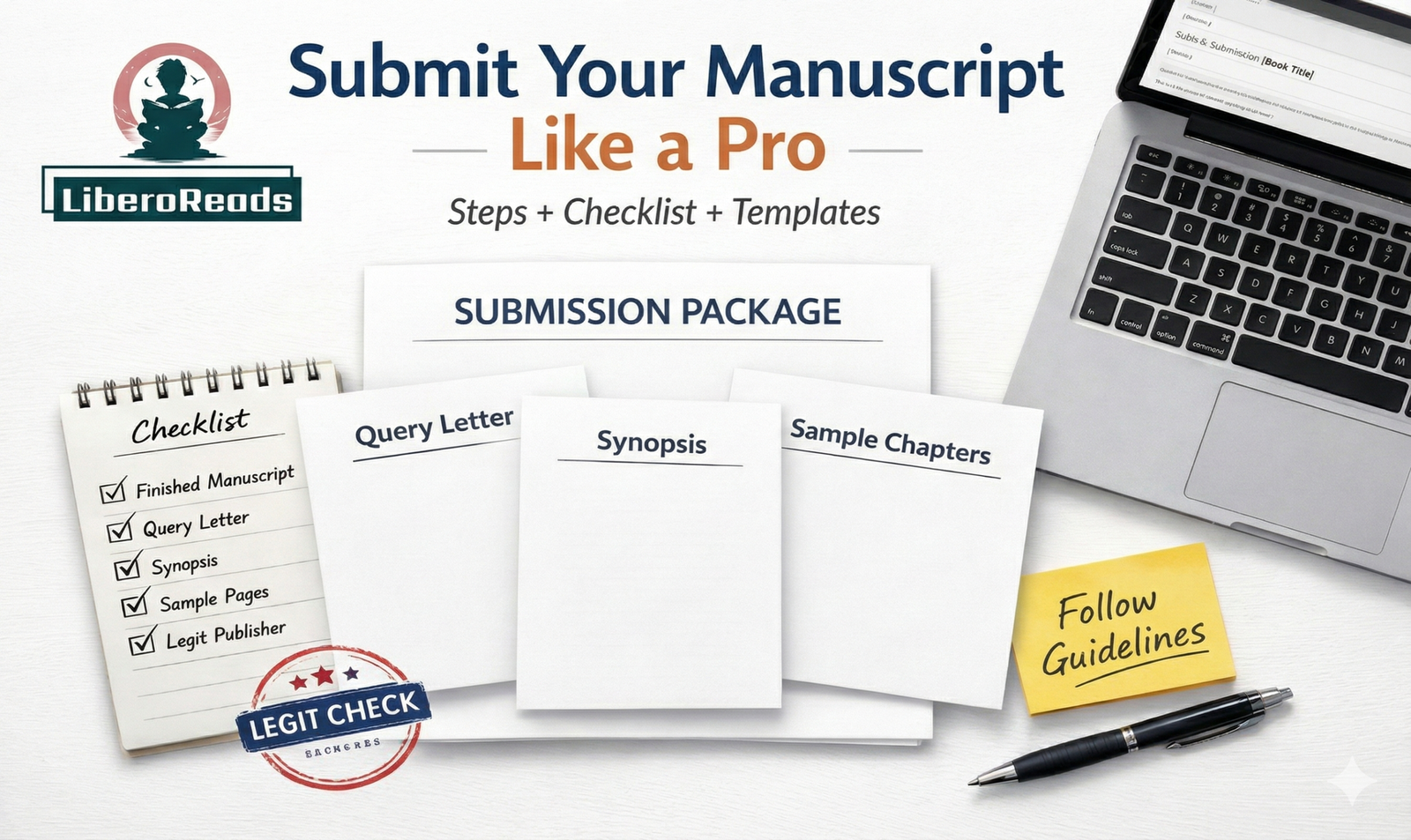
5) Build your submission package
Most agents/publishers ask for some mix of:
-
Query letter (pitch + positioning)
-
Synopsis (full story summary, including ending)
-
Sample chapters/pages (usually the opening)
-
Short author bio
Nonfiction often requires a proposal. Always check the exact submission guidelines.
6) Create a targeted list (fit-first, not volume-first)
Build a list of 10–25 strong matches. For each, record genre fit, recent titles, required materials, and the submission method (form, portal, email).
Quick Tip: A smaller, well-matched list usually beats 100 random submissions.
7) Follow submission guidelines exactly
If they ask for pasted pages (not attachments), a specific subject line, or a one-page synopsis, do exactly that. This is one of the easiest rejection triggers to avoid.
8) Track submissions + timelines + follow up professionally
Use a simple tracker: where you submitted, when, what you sent, and when (or whether) a follow-up is allowed. If they say “no follow-ups,” respect it.

Publishers Accepting Unsolicited Manuscripts: How to Find Them and Vet Them
Where to find them
Start with the most reliable sources:
-
Publisher websites (submission page + catalog)
-
Small presses in your genre
-
Acknowledgments pages in books like yours (who published them, who represented them)
Vet legitimacy (red flags)
Not every “publisher” is a real publisher. Watch for:
-
Required payments, “mandatory packages,” or pressure upsells
-
“Guaranteed acceptance” or “bestseller” promises
-
No clear catalog, team, or distribution footprint
-
Contracts that are vague, rushed, or hard to understand
When you’re unsure, scan Writer Beware red flags and the SFWA Writer Beware resource hub before you submit.
Manuscript Editing: The Highest-Leverage Upgrade Before You Submit
Manuscript editing is the fastest way to raise your odds—because it improves what decision-makers actually judge: the pages.
Strong editing typically improves:
-
Clarity and pacing
-
Voice consistency
-
Professionalism (fewer errors and distractions)
-
Your opening chapter (the make-or-break zone)
When proofreading is enough (and when it isn’t)
-
Proofreading is enough when the structure is solid and you’re mainly catching typos.
-
Editing is needed when readers feel confused, bored, or unconvinced—even if they “like the idea.”
Common Reasons Manuscripts Get Rejected (Fix These First)
-
Mismatch: wrong genre/audience for that publisher or agent
-
Weak opening pages: slow start, unclear stakes, confusing voice/POV
-
Unclear pitch: query doesn’t explain what the book is and who it’s for
-
Rushed manuscript editing: inconsistency, grammar issues, uneven pacing
-
Guidelines ignored: wrong format, wrong materials, wrong method
Common Mistake: Assuming rejection means “bad book.” Often it means “wrong fit” or “not ready yet.”
A Simple Submission Checklist (Save This)
Before you submit manuscript to publisher (or agent), confirm you have:
-
Final revised book manuscript (outside feedback included)
-
One-sentence hook + short pitch paragraph
-
Query letter tailored to the recipient
-
Synopsis (length requested; includes ending)
-
Sample pages in the exact requested format
-
Clean manuscript format (easy to review)
-
Target list with proof of genre fit
-
Submission tracker + follow-up rules
-
Scam check completed
Templates You Can Use Today
1) Query letter mini-template
Subject: Query — [BOOK TITLE] ([WORD COUNT], [GENRE])
Dear [Agent/Editor Name],I’m seeking representation/publication for [BOOK TITLE], a [genre] complete at [word count] words. It will appeal to readers of [Comp Title 1] and
[Comp Title 2].
Hook (1 sentence): [Character + goal + obstacle + stakes]Brief pitch (2–4 sentences): [What happens, what escalates, what changes]
Why you: [1 sentence: a title they published, a line they represent, etc.]Bio: [1–2 lines]
Thank you for your time,[Name] | [Email]
2) Submission email template
Subject: Submission — [BOOK TITLE] ([GENRE], [WORD COUNT])
Hello [Editor/Team Name],Per your submission guidelines, I’m submitting [BOOK TITLE], a [genre] complete at [word count] words.
-
Logline: [1 sentence hook]
-
Materials included: [synopsis + sample pages + anything else they requested]
-
Why I’m submitting to you: [1–2 lines showing fit with their catalog]
Thank you for considering my work,[Name] | [Email]
Conclusion
Submitting doesn’t have to be a mystery. Pick the right route (agent, direct, or small press), build a clean submission package, and submit with precision—not desperation. Your one action today: choose 10 ideal targets and match your materials to their submission guidelines.
If you want support making your manuscript market-ready, you can Schedule Free Consultation.